Bastien Carreres
Postdoctoral Associate at Duke University
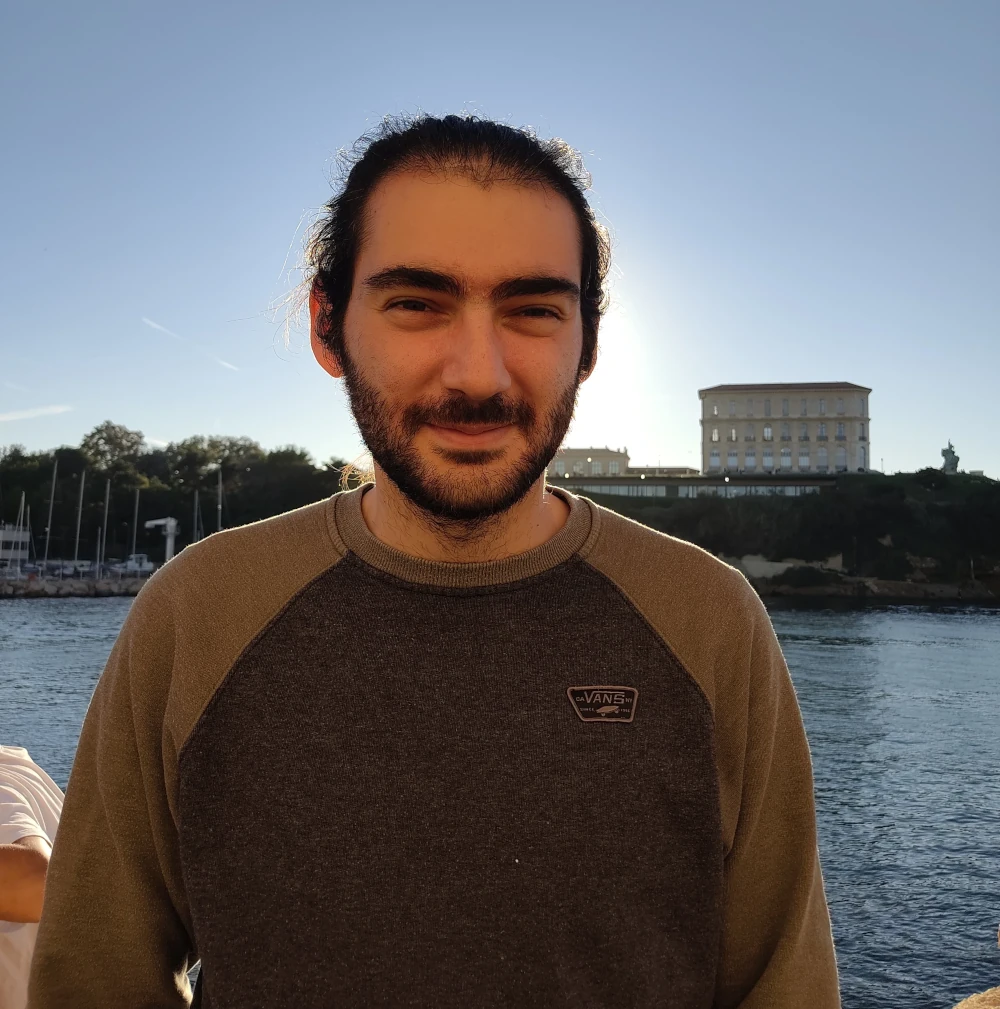
Physics Building
Duke University
Durham, NC, USA
I am a Postdoctoral Associate in the Cosmology group at Duke University, working on the measurement of the growth rate of structures with type Ia supernovae.
My research focuses on understanding the acceleration of the expansion of the Universe and the nature of dark energy. I use type Ia supernovae in the nearby Universe to measure distances and infer the peculiar velocity field of their host galaxies. This field is linked to the growth of structures, and allows us to test the standard model of cosmology and general relativity.
I am a member of the Zwicky Transient Facility (ZTF), of the Rubin Observatory LSST Dark Energy Science Collaboration (DESC), and of the Dark Energy Bedrock All-Sky Supernova program (DEBASS). I am also working on the TITAN SN Ia sample from ATLAS, for which I will perform the growth-rate measurement.
I obtained my PhD in astrophysics and cosmology at the Centre de Physique des Particules de Marseille (CPPM), after a master’s degree in subatomic physics and cosmology at Université Grenoble Alpes.
Selected Publications
2026
- Debiasing Local Cluster Infall Reveals \(\bf H_0\): Application to the Virgo ClusterarXiv e-prints, Oct 2026
- Field-level inference of growth rate from DESI BGS galaxy and ZTF supernova simulationsarXiv e-prints, Sep 2026

2025
-
In this paper, I study the impact of intrinsic scatter of SNe Ia on the measurement of \(f\sigma_8\). This study is done through the simulation of the full low-z LSST SNe Ia sample for different intrinsic scatter models. We found that the most realistic model of intrinsic scatter causes non-Gaussianities in the Hubble diagram residuals, resulting in a bias on \(f\sigma_8\).
-
This paper presents the FLIP Python library. This library is based on codes developed during my PhD and proposes a more general framework for the constraint of the growth rate of structure. I actively participated in the development of FLIP and in the writing of this paper.
-
This paper is part of the second data release of ZTF SNe Ia. In this paper, I study the impact of the peculiar velocity (PV) systematics on the Hubble diagram of the ZTF SN Ia DR2 sample. We show that not taking into account the full PV covariance matrix can lead to a slight underestimation of the error on the Hubble constant \(H_0\)and could shift its value by \(∼\) 1 km s\(^-1\).


2023
-
This paper is the main publication of my thesis. In this paper, I present my work to prepare for the future measurement of the growth rate of structure (\(f\sigma_8\)) from ZTF SN Ia data. I describe my realistic simulation of the ZTF SN Ia sample and, using these simulations, I study the biases and systematics that can affect the measurement of \(f\sigma_8\). I show that using SN Ia data from the full 6 years of the ZTF II sample with a cut at a redshift of \(z < 0.06\)to avoid selection due to magnitude limit, we can expect an unbiased measurement of \(f\sigma_8\)with an error of \(∼19%\).
